Despite telecommuting's promise of big cost savings and increased productivity, most businesses aren't ready to let employees work at home yet.
 |
| Infographics: Telecommuting Trends © CreditDonkey |
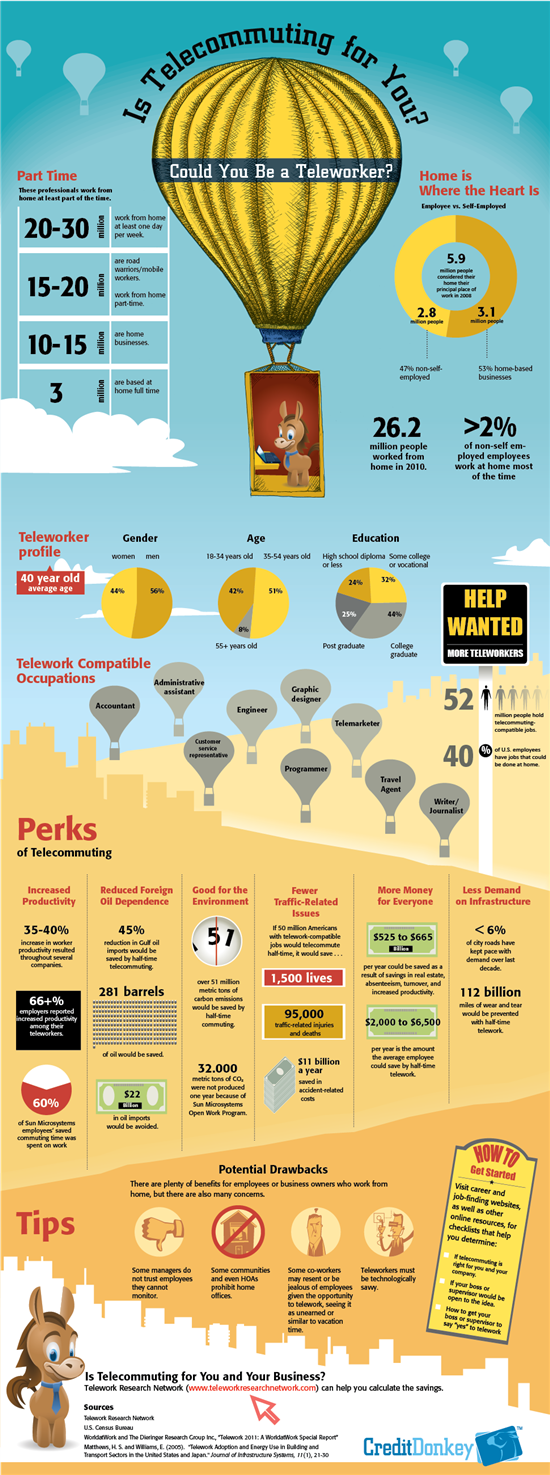
Experts once predicted that telecommuting would be the norm by the early 21st century, but employer mistrust of unmonitored workers is delaying the dreams of American employees, 80% of whom would like to work from home, according to recent survey data from WorldatWork. Though the number of workers who call home their primary workplace jumped by over 60 percent from 2005-2009, says Telework Research Network, this translates to only 2.8 million employees.
However, that figure does not include home-based businesses, which accounted for another 3.1 million workers in 2008, or employees who worked from home at least one day a week, which accounts for another 20-30 million workers.
“Part-time teleworkers include millions of mobile workers (“road warriors”) who charge a lot of business expenses to their credit cards,” said Charles Tran, founder of CreditDonkey. “What’s more, 10.3 percent of small business owners use credit cards to help finance their start-ups.”
Tran noted that the typical teleworker is a college-educated 35- to 54-year-old, non-union employee working in telecommuting-compatible professions such as accounting, graphic design, engineering, computer programming, journalism/copywriting, administrative support or customer service. At least 40% of the U.S. workforce (52 million people) holds telework-compatible jobs.
According to research compiled from the U.S. Census Bureau and Telework Research Network, among the potential benefits of telework:
- Nearly 6 million people considered their home their principal place of work. Of which, 53% were home-based business.
- Half-time telecommuting (2.4 days per week) would reduce current U.S. imports of Gulf oil by 45 percent annually, saving $22 billion.
- If all Americans with telework-compatible jobs worked from home half-time, it could prevent 95,000 traffic-related injuries and deaths each year.
- Companies would save $525 to $665 billion per year, thanks to reduced real estate, turnover and absenteeism costs, as well as increased employee productivity.
- More than 66 percent of companies that permit telecommuting have reported increased productivity among teleworkers.
“Despite the bottom-line benefits, it’s mostly the larger companies (those with 100+ employees) that are hopping on the telework bandwagon,” says Tran. “In the long term, it’s inevitable that many more jobs will be done at home, but in the near term, the spirit is willing, but employer trust is weak.”
Telecommuting Disadvantages
There are plenty of benefits for employees or business owners who work from home, there are also many concerns. Some of these issues are outlined below.
- There is the possibility of your presence or good performance being overlooked when compared with being in the office full time. Although some believe if you stay motivated and get a lot of work done, it mitigates this issue.
- Some employers are afraid to ask about telecommuting because they view it as an accommodation the employer makes for the employee. Employees are hesitant to so in an economically difficult time.
- Some co-workers may resent or be jealous of employees given the opportunity to telework, seeing it as unearned or similar to vacation time.
- Most employers will not consider telecommuting options for new employees.
- Some managers do not trust employees they cannot monitor.
- Telecommuters must be motivated and self-directed.
- Teleworkers must be technologically savvy.
- Some managers think telework inhibits collaboration.
- Double taxation issues may arise in states that tax home-based workers.
- Safety issues have led to concern about liability and workers compensation issues.
- Some communities and even HOAs prohibit home offices.
How to Get Started
Visit career and job-finding websites, as well as other online resources, for checklists that help you determine:
- If telecommuting is right for you and your company.
- If your boss or supervisor would be open to the idea.
- How to get your boss or supervisor to say “yes” to telework.
Kelly Teh is a contributing features writer at CreditDonkey, a credit card comparison and reviews website. Write to Kelly Teh at kelly@creditdonkey.com. Follow us on Twitter and Facebook for our latest posts.
Note: This website is made possible through financial relationships with some of the products and services mentioned on this site. We may receive compensation if you shop through links in our content. You do not have to use our links, but you help support CreditDonkey if you do.